
Continuous radon monitors vs. charcoal kits
Charcoal kits give you one average. Continuous radon monitors show you every hour. Here is what that difference means for your schools, your HVAC schedule, and your budget.
Hourly readings
See occupied school hours separately from empty overnight peaks.
Fast lab reports
Location reports within 2–3 minutes of upload; project summaries signed within 2 hours of completion.
Reusable monitors
Run 48–96-hour deployments, testing all occupied ground-contact rooms simultaneously, then move monitors to the next school.
HVAC first
Test schedule changes before spending on mitigation systems.
Common questions
What is a continuous radon monitor?
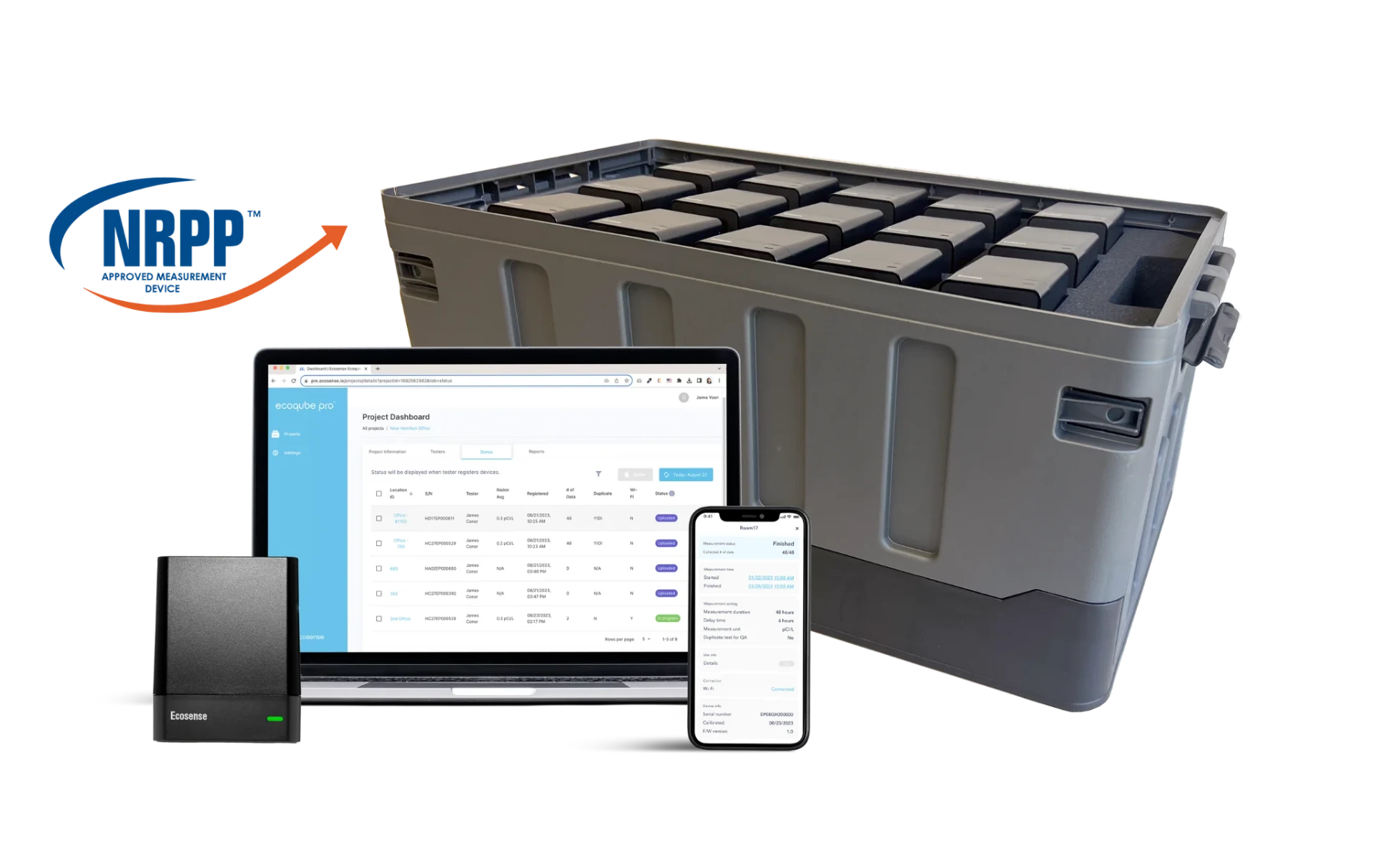
A continuous radon monitor (CRM), such as the EcoQube Pro, provides hourly radon data. Instead of one blended number, you can examine occupied school hours separately from empty overnight periods.
What approvals do EcoQube Pro and Ecosense Lab hold?
EcoQube Pro monitors are approved by the National Radon Proficiency Program (NRPP) and all state radon licensing agencies. Ecosense is an NRPP-approved analytical lab and is accredited by the New York Environmental Laboratory Approval Program (NY ELAP). NY ELAP evaluates laboratories to ensure they follow specific national quality standards outlined by The NELAC Institute.
How long should a school radon test run?
EcoQube Pro deployment periods can be set from 48–96 hours. ANSI-AARST standards for school testing require a minimum 48-hour test period, with all occupied ground-contact rooms in the building tested simultaneously.
How quickly are EcoQube Pro results and signed reports available?
Ecosense Lab analyzes each location’s hourly data within 2–3 minutes of mobile-app upload and posts reports on the dashboard. A complete school project summary can then be generated in a couple of minutes. The Ecosense Lab director reviews and signs project summary reports within 2 hours of completion, and the project manager receives an automatic email immediately after signing.
How does charcoal testing differ, and how long do results take?
Passive charcoal canisters absorb radon throughout the exposure window, blending overnight peaks and daytime lows into a single average. They are single-use. Once the exposure window closes, a technician or school official must immediately seal all charcoal canisters to stop further absorption and securely box them with the corresponding chain-of-custody data sheets. Shipping takes 2–3 days; delays may allow enough radon decay to render samples unusable. Upon receipt, certified laboratories place canisters in a lead-shielded chamber to count gamma radiation. Standard turnaround for large batches is typically 2–3 business days to analyze, scan, and generate individual PDF results for each room. The project manager must then manually create a school survey summary report. Total turnaround: 1–2 weeks.
Why does hourly data matter in a school?
When HVAC shuts off overnight, radon levels can crest in an empty building. Hourly data helps distinguish these overnight peaks from occupied-hours exposure and can reveal opportunities for zero-capital HVAC scheduling adjustments before buying major hardware. Results vary by building; schedule changes are not guaranteed to resolve elevated radon.
Can monitors be reused?
Yes. EcoQube Pro monitors are reusable and leased through Lease & Move. Plan each school deployment to test all occupied ground-contact rooms simultaneously, then move the monitors to the next school after the deployment ends.
Charcoal kits average.
Continuous monitoring reveals.
A direct comparison of traditional charcoal test kits with EcoQube Pro CRMs.
The HVAC Schedule Blindspot
An average charcoal kit won’t show you the reality of your building’s airflow. When a school’s HVAC system shuts off overnight to conserve energy, radon gas levels naturally crest. Charcoal canisters absorb this gas 24/7, yielding an artificially inflated reading.
By contrast, the EcoQube Pro maps radon levels continuously. Facility managers frequently discover that simply adjusting the morning HVAC startup sequence by 60 minutes flushes out any overnight radon pooling completely—delivering safe, compliant air precisely when students walk through the doors without digging a single sub-slab depressurization trench.
$6 per test with leasing
Example: 20 schools with 30 rooms each is 600 tests. At an estimated $20 per charcoal kit that is $12,000; with EcoQube Pro leasing it is $3,600, a saving of $8,400 (70% lower).
Try the savings calculatorReady to price your district?
Tell us how many schools you have. We’ll build a Lease & Move plan around them.
Get District Quote